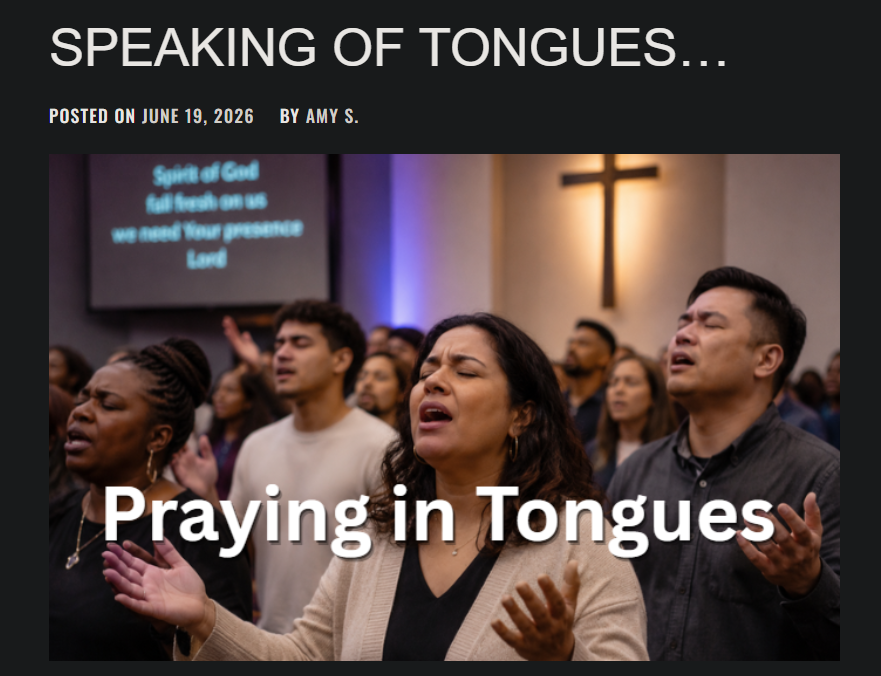
I recently read an article by Amy S. (Amy Spreeman) at Berean Research called “Speaking of Tongues.” The same week, I had various posts pop up from others talking about how tongues are not for today, especially the Pentecostal/Charismatic “gibberish.”
Amy S. wrote, “In Acts 2:4-21, the gift of tongues consisted of real human languages. The Holy Spirit enabled believers to speak languages they had never learned so that people from many nations could hear the Gospel in their own language.”
She concluded her article with: “Are these experiences truly from God? No one can say with absolute certainty about any particular person’s experience. While I won’t question the sincerity of those who have had such experiences, the key question remains: Are these practices biblical? Scripture must be our final authority. If we cannot clearly support a spiritual experience or practice from the Bible—rightly interpreted and in context—then we should not pursue or promote it as normative for the Christian life.”
I absolutely agree with this. We must support spiritual experiences and practices from the Bible “—rightly interpreted and in context.”
That’s why I offer this Different Point of View.
This is not a rebuttal to Amy S.’s article. It’s simply going back to Scripture to see if there might be another (and hopefully more accurate) interpretation of Scripture.
The paper is 13 pages long, but it’s an easy read. Since it is so long, I’m making it into a PDF for download. I hope it blesses you.
Tongues
A Different Point of View
RavingMadman.com
(Scripture is from ESV and NIV unless otherwise noted.)
In June 2026, I read an article at BereanResearch.org about speaking in tongues[i] (they’re against it). At the same time, my Facebook feed had a number of people/groups speaking against tongues. So I wanted to present a differing viewpoint from Scripture. This isn’t really a rebuttal. It’s just what I’ve learned about tongues from Scripture, with (I hope) some answers to common objections about tongues.
Most non-tongue-talkers get nearly all of their doctrine about tongues from Acts 2 and a misunderstanding of 1 Corinthians 13.
Let’s look at the following teachings about tongues:
- Are tongues still for today, or were they just signs for the early church?
- What is the purpose of tongues?
- Are there different kinds of tongues?
- Are tongues meant for public use or private use?
- Can all speak in tongues?
- What is actually happening when a person speaks in tongues?
- What does science say about tongues?
- What is the gift of interpretation of tongues?
- What is Paul saying about Isaiah 28 and the “sign for unbelievers”?
- What does Paul teach us about tongues in 1 Corinthians 14?
- Conclusion
- Are tongues still for today, or were they just signs for the early church?
Most non-tongue-talkers (NTTs) take their theology of the timeline of tongues from 1 Corinthians 13:8-10 combined with 1 Corinthians 14:21-22.
They say that (1) tongues were a sign for the Jews (even though Paul says “unbelievers” and is speaking to a mostly Gentile congregation), and (2) when the Bible was completed, tongues ceased.
Tongues as a sign. 1 Cor 14:22-23 tells us:
Thus tongues are a sign not for believers but for unbelievers, while prophecy is a sign not for unbelievers but for believers. If, therefore, the whole church comes together and all speak in tongues, and outsiders or unbelievers enter, will they not say that you are out of your minds?
Tongues are a sign for unbelievers, but if an unbeliever comes in when the whole church is speaking in tongues, they’ll think you’re nuts.
Prophecy is a sign for believers. If an unbeliever hears people prophesying, he is “convicted by all, called to account by all, the secrets of his heart are disclosed,” causing him to fall on his face and worship God, declaring that God is really among you. (see 1 Cor 14:24-25).
One would think just the opposite would occur if tongues were a sign for unbelievers.
However, we see Paul’s conclusion when we look at the Day of Pentecost. When the Jews heard the believers speaking in tongues, were they convicted of sin? Were the secrets of their hearts disclosed? Did they fall on their faces and worship God? Did they declare that God was really among them?
Nope.
Instead, they were “amazed and astonished.” They were “amazed and perplexed.” They were confused (“What does this mean?”). And some said exactly what Paul said they would: “They’re drunk. They’re out of their minds.”
Notice that there was no conviction of sin. Notice that no one cried out, “Brothers, what shall we do?” like they did a few minutes later in Acts 2:37. There was only amazement, astonishment, perplexity, confusion, and mocking.
Only when Peter stood up and preached the Gospel in a common language were the hearers convicted and believed the Gospel.
Have tongues ceased? For some reason that I’ve yet to figure out, cessationists claim that 1 Cor 13:10 refers to the completed Bible, even though the passage tells us that when the perfect comes, we will see face to face and know fully. We’ve had the completed Bible for 1600 years, yet we still don’t see face to face or know fully. This conversation and all the divisions in the Church prove it.
So what is the “perfect”? Paul tells us in chapter 1, verses 7 and 8.
…so that you are not lacking in any spiritual gift, as you wait for the revealing of our Lord Jesus Christ, who will sustain you to the end, guiltless in the day of our Lord Jesus Christ.
Paul is telling us that the spiritual gifts are meant for the Church as we wait for the revealing of our Lord Jesus Christ on the Day of our Lord Jesus Christ. That is the perfect that he is referring to in chapter thirteen.
This includes tongues and prophecy.
- What is the purpose of tongues?
Non-tongue-talkers tell us that “The Holy Spirit enabled believers to speak languages they had never learned so that people from many nations could hear the Gospel in their own language.”[ii] This is based on Acts 2.
As we’ve seen above, when the believers spoke in tongues on the Day of Pentecost, no one was convicted of sin, and no one believed on Jesus. It does not appear that the Gospel was preached, especially in light of the fact that just a few minutes later, Peter preached the Gospel to them, and 3000 were convicted and believed on Jesus, and were baptized.
If the believers were not preaching the Gospel when they spoke in tongues, what were they doing? The Bible tells us: “We hear them telling in our own tongues the mighty works of God.”
The believers were not preaching. They were praising.
Let’s look at what Paul says we do when we speak in tongues. We speak to God (1 Cor 14:2 and 28), we pray (v. 15), we sing (v. 15), we praise God (v. 16), and we give thanks (v. 17).
This lines up with the next time we see tongues in Acts.
For they were hearing them speaking in tongues and extolling God. (Acts 10:46)
The word translated “extolling” is translated as “magnify” in the KJV and “praising” in the NIV.
What is the purpose of tongues? Paul tells us that the purpose of tongues is simply to edify — first, the individual speaking in tongues, and second, the church when an interpretation is given.
Paul never mentions that tongues are used for preaching the Gospel.
If we look at the two remaining times that tongues were spoken in the book of Acts, we find that they could not have been preaching the Gospel.
In Acts 10, Peter is speaking in a common language, when suddenly the Holy Spirit fell on the hearers, and they began speaking in tongues. Did the Gentiles suddenly begin preaching the Gospel to the Jewish believers, including the Apostle Peter?
In Acts 19, Paul found some disciples that had not “even heard that there is a Holy Spirit.” Paul laid his hands on them, and they began speaking in tongues and prophesying. Again, no Gospel was preached through tongues.
So, tongues are not for preaching the Gospel. They are for edification and praising God.
- Are there different kinds of tongues?
By this, I mean, are tongues known languages or are they “gibberish,” or is there a mix?
In Acts 2, 120 believers spoke in tongues, and they were understood in 15 different languages.
In Acts 10 and 19, there is no indication that anyone understood the tongues.
That brings us to 1 Corinthians 14:2.
For one who speaks in a tongue speaks not to men but to God; for no one understands him, but he utters mysteries in the Spirit.
This verse teaches us four things about tongues.
- One who speaks in a tongue does not speak to men.
- One who speaks in a tongue…(speaks) to God.
- No one understands the one speaking in tongues.
- The one speaking in tongues utters mysteries with his spirit.
When it says “not to men,” the Greek word is ou. Strong’s tells us that this is an “absolutely negative” meaning “no, not, never, none, nothing.”
When it says “no one understands,” the Greek word is oudeis, which means “none, nobody, nothing.”
Notice that Paul is not saying, “When anyone of you speak in tongues in your meetings…” no one understands. He’s giving a broad statement which is applicable to us today.
In this verse — which seems to be the only definition of what tongues is in the whole of Scripture — we learn that when a person speaks in tongues, he is not speaking to any person, because even if he did, the person would have no ability to understand him.
But then we have to ask, didn’t the Jews understand the tongues spoken on the day of Pentecost? And the answer is yes.
Which leads us to ask, does this mean there is more than one kind of tongue — one that is understood and one that is not (that is, actual languages vs. “gibberish”)? Again, the answer is yes, UNLESS we have an incomplete understanding of what happened on the Day of Pentecost.
[Some believe that what happened on the Day of Pentecost was a miracle of hearing, meaning that the believers spoke in tongues (possibly a gibberish), but were understood by the Jews. Most scholars disagree with this belief, but there have been Christian scholars throughout history that have considered this theory.]
This leads us to 1 Corinthians 12:10, where Paul tells us that one of the manifestations of the Spirit is “speaking in various kinds of tongues.” This could mean “different languages,” but it could also mean “different kinds” — such as tongues that are understood by someone, as well as tongues that are understood by no one.
This can go even further with tongues that are meant to edify only the speaker and tongues that are meant to edify the church, which brings us to our next point to consider…
- Are tongues meant for public use or private use?
Non-tongue-talkers (NTTs) love to claim that tongues are not a private prayer language. But what does Scripture say?
Here we need to focus on what 1 Corinthians 14 teaches us about tongues.
Paul very clearly tells us that tongues are good:
The one who speaks in a tongue builds up himself… (1Co 14:4)
Now I want you all to speak in tongues… (1Co 14:5)
I thank God that I speak in tongues more than all of you. (1Co 14:18)
But he has a qualification:
Nevertheless, in church I would rather speak five words with my mind in order to instruct others, than ten thousand words in a tongue. (1Co 14:19)
So, what is the rule for speaking in tongues in church meetings?
If any speak in a tongue, let there be only two or at most three, and each in turn, and let someone interpret. (1Co 14:27)
We must consider something. If Paul talked in tongues “more than all of you,” but he didn’t speak in tongues in church meetings, where did he speak in tongues? The only logical answer is that he did so in private.
Let’s look at one other verse that shows that tongues can be a “private prayer language.”
But if there is no one to interpret, let each of them keep silent in church and speak to himself and to God. (1Co 14:28)
I can’t count how many times NTTs have said, “Paul said that if there is no one to interpret then the one speaking in tongues needs to SHUT UP.”
But that isn’t what Paul said. He said, “Keep silent in the church and speak to himself and to God.” Otherwise, “You can continue praying in tongues, but do it quietly so that you do not disturb others.”
Notice three things about this. (1) It is private. It’s between you and God alone. (2) It’s prayer. (3) It’s praying in tongues. AKA, a private prayer language.
Are tongues meant for private or public use? Yes.
It seems that there are two kinds of public tongues. One where the tongue is understood. This could be either one speaks in a foreign language where someone who speaks the language understands it, or it could be a tongue where a supernatural interpretation is given for the edification of the church.
But there also seems to be a private tongue that Paul encourages people to speak in for personal edification.
Now some NTTs have said that tongues is a selfish gift because it edifies the speaker, but not the church. But if edifying oneself by speaking in tongues is selfish, then Paul was the most selfish of all because he spoke in tongues more than all.
Consider this: When Paul says that he wanted “you all” to speak in tongues, and that he spoke in tongues “more than all of you,” which tongues was he referring to? Remember, when he said “Now I want you all to speak in tongues,” he had just taught us five things about tongues: the tongue speaker is not speaking to man, the speaker is speaking to God, no one understands the tongue, the speaker is uttering mysteries, and the one speaking in tongues is building up himself (1 Cor 14:2 and 4).
This is the kind of tongue that he wants “you all” to speak in and that he thanks God that he speaks in.
- Can all speak in tongues?
In 1 Corinthians 12:30, Paul asks, “Do all speak with tongues Do all interpret?”
The answer, of course, implies, “No. Not everyone can speak in tongues.”
But why does Paul desire “you all” to speak in tongues? Could it be because there are different kinds of tongues?
Could there be a difference between the public tongues which are interpreted, and the private tongues that (usually) are not?
Before we write off that Paul means, “No. Not everyone speaks in tongues,” let’s look at the book of Acts again.
In Acts 2, we read that the 120 were all together in one place on the day of Pentecost. (Some people believe it was only the 12, but the majority of scholars believe it was 120.) When the Holy Spirit was poured out, “they were all filled with the Holy Spirit and began to speak in other tongues as the Spirit gave them utterance” (Acts 2:4).
Of the 120, how many began speaking in tongues? All of them.
In Acts 10, Peter found “many persons gathered” at Cornelius’ house. As Peter was speaking, “the Holy Spirit fell on all who heard the word.” The implication is that all of the “many persons” spoke in tongues.
In Acts 19, Paul met “about twelve men” who all spoke in tongues and prophesied when he laid his hands on them.
In three instances of groups of people receiving the Holy Spirit, how many of them spoke in tongues? All of them.
If we couple this with Paul’s desire, “I would like every one of you to speak in tongues,” then it seems safe to assume that all believers may speak in devotional or private tongues, while only a few will speak in a tongue meant for others.
- What is actually happening when a person speaks in tongues?
Paul tells us that when a person speaks in tongues, they are edifying themselves.
How?
I believe it is the last part of 1 Corinthians 14:2 that tells us — “…but he utters mysteries in the Spirit.”
This verse has confused people, both those that speak in tongues and those that don’t.
The “mysteries” isn’t what the person is doing. It is what he is uttering.
For this, we need to see how Paul uses the word “mysteries” in his letters. He wrote of “a secret and hidden wisdom of God” (1 Cor 2:7), “the mystery of His will” (Eph. 1:9), “the mystery of the gospel” (Eph 6:19), “the glory of this mystery, which is Christ in you, the hope of glory” (Col 1:27), “the mystery of godliness” (1 Tim 3:16).
The only time Paul uses this word in a negative way is in 2 Thessalonians 2:7, when he says, “For the mystery of lawlessness is already at work.” Every other time Paul uses this word it’s in a positive context.
When we pray in tongues, we are speaking to God about such things as the mystery of the Gospel, the mystery of godliness, the hidden wisdom of God, and about Christ in you.
Basically, when a person speaks in tongues, they are speaking the secret things of God into their spirit. This builds the person up (edifies them).
If you want, dive deeper into this by looking at the work of the Holy Spirit in passages such as 1 Cor. 2:6-16, John 14:15-31, John 16:5-15, etc. When we pray these “mysteries,” the Holy Spirit is giving us a better understanding of who Christ is, what He has done for us, and who we are in Him — which is what these other passages say He will do.
Speaking in tongues is not something we should be afraid of or discourage. It’s something that we should do every day as part of our growth in Christ. We should read, study, and meditate on the Scriptures daily, and then spend much time praying in tongues to allow the Holy Spirit to do His work of teaching, reminding, and revealing Christ in us.
- What does science say about tongues?
Let’s move away from Scripture for just a moment, and see what science tells us about tongues.
Linguists have concluded that tongues “represent no known natural language and in fact no language that was ever spoken or ever will be spoken by human beings as their native tongue.”[iii] This same article also says that there have been instances of a person speaking in tongues in known languages, but the scientists feel that it was probably a language they had learned but forgotten. This doesn’t make much sense when one considers that when a person speaks a tongue in a known language, it is very specifically connected to God and the Bible. These are not things that a person tends to learn about a language that they have easily forgotten.
Another article states that a researcher (clinical psychologist and ordained Lutheran minister John Kildahl) discovered in 1972 that people who pray in tongues suffer less stress.[iv] This same article goes on to say a 2003 study of 991 male evangelical clergy found that tongues “was linked to stable extraversion — the tendency to be outgoing, energetic, and sociable.” And that a 1995 survey found that those training for Pentecostal ministry who spoke in tongues “were far less neurotic than the general population.”
Dr. Josh Brahinsky recently published a book (March 2026) called Tongues of Fire: How Charismatic Prayer Changes Evangelical Brains and Inspires Spirit-Filled Activism. In an interview with Joseph Lear,[v] Dr. Brahinsky (a non-believing Jewish anthropologist) shows that when a person speaks in tongues, he is not faking it. The tongues actually change the brain. When a person prays in tongues for a longer period of time, “they would have a greater positive change in creativity during that prayer block.”
He then goes on to say that when people pray in tongues, they are letting go, or surrendering, but when they finish, they feel more powerful — “I feel like I can do something…I feel more confident and I feel less afraid to speak up in front of people or [I’m] able to be part of a community that’s doing things and even just able to act in the world.”
Can science show how tongues edifies the spirit of a person? Unfortunately, no. We can only look at the anecdotal evidence of those who speak in tongues to see this. But science does show that when a person speaks in tongues, something positive happens in the body, mind and emotions.
- What is the gift of interpretation of tongues?
Another big misunderstanding from NTTs is the gift of interpretation. Many NTTs seem to think that interpretation of tongues is simply someone understanding the language. For example, I speak in tongues. As I do, you hear Chinese. As a fluent Chinese speaker, you then interpret what was said.
That is not what the gift of the interpretation of tongues is. Interpretation of tongues is not a natural ability. It is a spiritual gift just as much as tongues or prophecy or healing is.
This is why Paul says that the person who spoke in tongues can also interpret what he says:
He who prophesies is greater than one who speaks in tongues, unless he interprets, so that the church may be edified. (1 Cor 14:5, NIV84) (1 Cor 14:5 in the ESV says “unless someone,” but most translations say “unless he.”)
Therefore, one who speaks in a tongue should pray for the power to interpret. (1 Cor 14:13, ESV)
This gift of interpretation can come from the same person who speaks in a tongue.
How do we know if an interpretation of tongues is real or accurate? Since Paul puts tongues and interpretation on the same level as prophecy, it stands to reason that they should give the same results, namely, when a tongue is interpreted, it should strengthen, encourage, and comfort (see 1 Cor 14:3, NIV) those who hear it. If it results in one of these three, then we should take it by faith that it is an accurate word, and judge it (or “weigh carefully”) according to 1 Cor 14:29.
- What is Paul saying about Isaiah 28 and the “sign for unbelievers”?
Let’s look at 1 Corinthians 14:20-25. Most NTTs use this segment to say something to the effect that tongues were a sign for the Jews, therefore they are no longer needed.
But what is Paul truly arguing when he says, “Brothers, stop thinking like children”?
Remember, when it comes to interpreting Scripture context is everything.
For context, what has Paul been talking about leading up to verse 20? The need to prophesy rather than speak in tongues in the church. Or, if we speak in tongues in the church, they need to be interpreted. What does Paul say after verse 25? He continues with an argument for orderly worship (such as tongues needing interpretation). This is the context of verses 20-25.
When he says, “Brothers, stop thinking like children,” he is continuing this argument.
When he quotes from Isaiah 28, he’s saying that “by people of strange lips and with a foreign tongue” I will speak to you, but the people of Israel “would not hear.”
In Isaiah, the people of Israel refused to listen to the prophet, thus God sent a people of “strange lips” to attack them. When the church is filled with uninterpreted tongues, we create the same roadblock for the unbeliever. They can’t hear and respond to our message in tongues because they can’t comprehend it without someone interpreting it. When it comes to tongues, Paul is saying, “You speak to them in tongues, but they will not hear.” Why? Because they cannot. They don’t understand the tongues. So what will happen when an unbeliever comes in and hears all of you speaking in tongues? They will say that “you are out of your minds.”
This is why the interpretation of tongues is so important. This is why prophecy is better than tongues in the church, because when an unbeliever comes in and hears people prophesying, he will be convicted of sin as the secrets of his heart are disclosed, and he will fall on his face and worship God.
- What does Paul teach us about tongues in 1 Corinthians 14?
1. Anyone who speaks in a tongue does not speak to men. (v.2)
2. Anyone who speaks in a tongue speaks to God. (v.2)
3. When someone speaks in tongues, no one understands him. (v.2)
These first three negate what many non-tongue-talkers say about tongues always being “known human languages.”
4. When someone speaks in tongues, he utters mysteries with his spirit. (v.2; see section VI)
5. When someone speaks in tongues, he edifies himself. (v.4)
6. Paul would like “every one of you” (in the Corinthian church) to speak in tongues. (v.5)
7. In the church, however, Paul would much rather we prophesied “so that the church may be edified.” (vv.4, 5)
8. Tongues with interpretation is on the same level as prophesying because it edifies the church, not just the individual. (v.5)
9. If a person speaks in tongues in a church, he should pray that he may interpret what he says. (v.13, see also v.5)
10. When we pray in tongues, our spirit prays. (v.14) See also “with his spirit” (v.2), “my spirit prays” (v.14), “pray with my spirit” (v.15), “sing with my spirit” (v.15), “praising God with your spirit” (v.16).
11. When we speak in tongues, we:
- speak to God (vv. 2 and 28),
- speak mysteries with our spirit (v.2),
- edify ourselves (v.4),
- pray (v.14),
- sing (v.15),
- praise God (v.16),
- give thanks (v.17).
12. Paul is thankful that he speaks in tongues more than the whole Corinthian Church (v.18).
13. HERE’S A WARNING ABOUT TONGUES: “But in the church I would rather speak five intelligible words to instruct others than ten thousand words in a tongue” (v.19).
14. HERE IS THE ONLY REBUKE ABOUT TONGUES: “Brothers, stop thinking like children. In regard to evil be infants, but in your thinking be adults” (v.20)
15. Tongues are a sign for unbelievers. (v.22).
16. When the church is busy speaking in tongues, and unbelievers come in, they will say that “you are out of your mind” (v.23). Compare this with Acts 2:6, 7, 12, 13 — “And at this sound the multitude came together, and they were bewildered… amazed and astonished… amazed and perplexed …But others mocking said, ‘They are filled with new wine.’”
17. In the church, only 2 or 3 can give a message in tongues, but someone must interpret. (v.27)
18. If there is no one with the gift of interpretation (see #9 above), then the one speaking in tongues should only speak to himself and God. (v.28)
19. Do not forbid speaking in tongues. (v.39)
- Conclusion
The conclusion is that tongues are for the whole church age. They are a gift given by the Holy Spirit to edify the church — both individually and corporately. When given in a church, they must be accompanied by the gift of the interpretation of tongues.
These tongues may at times be understood as known human languages. But this is not true the majority of the time. To confirm this, read 1 Corinthians 14, but replace the word tongue or tongues with the phrase “known human languages.” (You really should do this.)
As we pray in tongues, we are “built up” according to Scripture. According to science, speaking in tongues help our mind and emotions.
The way this edification comes is by praying mysteries with our spirits. These mysteries are the secret things of God that the Holy Spirit enables us to know regarding the Father’s will, Christ, the Church, godliness, and such things.
We can also use tongues to praise and thank God.
We must not forbid speaking in tongues.
[i] https://bereanresearch.org/speaking-of-tongues/
[ii] https://bereanresearch.org/speaking-of-tongues/ (This is something Amy S., wrote, but it’s something that all NTTs repeat in some form.)
[iii] https://frame-poythress.org/linguistic-and-sociological-analyses-of-modern-tongues-speaking-their-contributions-and-limitations/#:~:text=Free%20vocalization%20(glossolalia)%20occurs%20when,units)%2C6%20(4)
[iv] See “The Neuroscience of Praying in the Spirit” (Medium). The 2003 study referenced is: Francis, L. J., & Kay, W. K. (2003), “The personality characteristics of Pentecostal ministry candidates.” The 1972 study is: Kildahl, J. P. (1972), “The Psychology of Speaking in Tongues.” (https://medium.com/@basileiapublishing/the-neuroscience-of-praying-in-the-spirit-c878d45a51e9)
[v] https://pastoraltheology.josephmlear.com/p/tongues-of-fire-with-dr-josh-brahinsky (all quotes are from this video)